Morrie's law

 Morrie's law is a special trigonometric identity. Its name is due to the physicist Richard Feynman, who used to refer to the identity under that name. Feynman picked that name because he learned it during his childhood from a boy with the name Morrie Jacobs and afterwards remembered it for all of his life.[1]

Identity and generalisationEdit

{\displaystyle \cos(20^{\circ })\cdot \cos(40^{\circ })\cdot \cos(80^{\circ })={\frac {1}{8}}.}

It is a special case of the more general identity

{\displaystyle 2^{n}\cdot \prod _{k=0}^{n-1}\cos(2^{k}\alpha )={\frac {\sin(2^{n}\alpha )}{\sin(\alpha )}}}

with n = 3 and α = 20° and the fact that

{\displaystyle {\frac {\sin(160^{\circ })}{\sin(20^{\circ })}}={\frac {\sin(180^{\circ }-20^{\circ })}{\sin(20^{\circ })}}=1,}

since

\sin(180^{\circ }-x)=\sin(x).

Similar identitiesEdit

A similar identity for the sine function also holds:

{\displaystyle \sin(20^{\circ })\cdot \sin(40^{\circ })\cdot \sin(80^{\circ })={\frac {\sqrt {3}}{8}}.}

Moreover, dividing the second identity by the first, the following identity is evident:

{\displaystyle \tan(20^{\circ })\cdot \tan(40^{\circ })\cdot \tan(80^{\circ })={\sqrt {3}}=\tan(60^{\circ }).}

ProofEdit

Geometric proof of Morrie's lawEdit

Regular nonagon {\displaystyle ABCDEFGHI} with O being the center of its circumcircle. Computing of the angles:
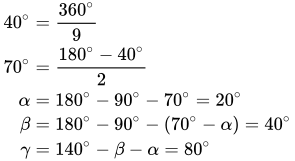
{\displaystyle {\begin{aligned}40^{\circ }&={\frac {360^{\circ }}{9}}\\70^{\circ }&={\frac {180^{\circ }-40^{\circ }}{2}}\\\alpha &=180^{\circ }-90^{\circ }-70^{\circ }=20^{\circ }\\\beta &=180^{\circ }-90^{\circ }-(70^{\circ }-\alpha )=40^{\circ }\\\gamma &=140^{\circ }-\beta -\alpha =80^{\circ }\end{aligned}}}

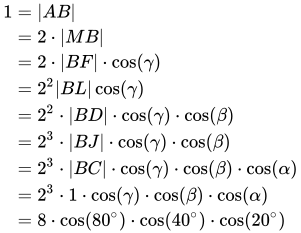
Consider a regular nonagon {\displaystyle ABCDEFGHI} with side length 1 and let M be the midpoint of ABL the midpoint {\displaystyle BF} and J the midpoint of BD. The inner angles of the nonagon equal {\displaystyle 140^{\circ }} and furthermore {\displaystyle \gamma =\angle FBM=80^{\circ }}{\displaystyle \beta =\angle DBF=40^{\circ }} and {\displaystyle \alpha =\angle CBD=20^{\circ }} (see graphic). Applying the cosinus definition in the right angle triangles {\displaystyle \triangle BFM}{\displaystyle \triangle BDL} and {\displaystyle \triangle BCJ} then yields the proof for Morrie's law:[2]

{\displaystyle {\begin{aligned}1&=|AB|\\&=2\cdot |MB|\\&=2\cdot |BF|\cdot \cos(\gamma )\\&=2^{2}|BL|\cos(\gamma )\\&=2^{2}\cdot |BD|\cdot \cos(\gamma )\cdot \cos(\beta )\\&=2^{3}\cdot |BJ|\cdot \cos(\gamma )\cdot \cos(\beta )\\&=2^{3}\cdot |BC|\cdot \cos(\gamma )\cdot \cos(\beta )\cdot \cos(\alpha )\\&=2^{3}\cdot 1\cdot \cos(\gamma )\cdot \cos(\beta )\cdot \cos(\alpha )\\&=8\cdot \cos(80^{\circ })\cdot \cos(40^{\circ })\cdot \cos(20^{\circ })\end{aligned}}}

Algebraic proof of the generalised identityEdit

Recall the double angle formula for the sine function

{\displaystyle \sin(2\alpha )=2\sin(\alpha )\cos(\alpha ).}

Solve for \cos(\alpha )

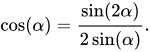
\cos(\alpha )={\frac  {\sin(2\alpha )}{2\sin(\alpha )}}.

It follows that:

{\displaystyle {\begin{aligned}\cos(2\alpha )&={\frac {\sin(4\alpha )}{2\sin(2\alpha )}}\\[6pt]\cos(4\alpha )&={\frac {\sin(8\alpha )}{2\sin(4\alpha )}}\\&\,\,\,\vdots \\\cos \left(2^{n-1}\alpha \right)&={\frac {\sin \left(2^{n}\alpha \right)}{2\sin \left(2^{n-1}\alpha \right)}}.\end{aligned}}}

Multiplying all of these expressions together yields:

{\displaystyle \cos(\alpha )\cos(2\alpha )\cos(4\alpha )\cdots \cos \left(2^{n-1}\alpha \right)={\frac {\sin(2\alpha )}{2\sin(\alpha )}}\cdot {\frac {\sin(4\alpha )}{2\sin(2\alpha )}}\cdot {\frac {\sin(8\alpha )}{2\sin(4\alpha )}}\cdots {\frac {\sin \left(2^{n}\alpha \right)}{2\sin \left(2^{n-1}\alpha \right)}}.}

The intermediate numerators and denominators cancel leaving only the first denominator, a power of 2 and the final numerator. Note that there are n terms in both sides of the expression. Thus,
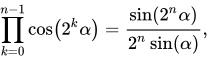
{\displaystyle \prod _{k=0}^{n-1}\cos \left(2^{k}\alpha \right)={\frac {\sin \left(2^{n}\alpha \right)}{2^{n}\sin(\alpha )}},}

which is equivalent to the generalization of Morrie's law.

This article uses material from the Wikipedia article
 Metasyntactic variable, which is released under the 
Creative Commons
Attribution-ShareAlike 3.0 Unported License
.