Michell solution

 The Michell solution is a general solution to the elasticity equations in polar coordinates () developed by J. H. Michell. The solution is such that the stress components are in the form of a Fourier series in .

Michell[1] showed that the general solution can be expressed in terms of an Airy stress function of the form
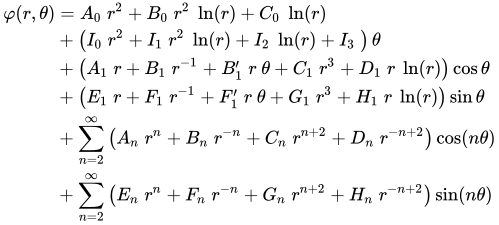
The terms  and  define a trivial null state of stress and are ignored.

Stress componentsEdit

The stress components can be obtained by substituting the Michell solution into the equations for stress in terms of the Airy stress function (in cylindrical coordinates). A table of stress components is shown below.[2]

\varphi \sigma _{{rr}}\,  
r^{2}\,2  
r^{2}~\ln r2~\ln r+1  
\ln r\,r^{{-2}}\,  
\theta \,{\displaystyle 0}  
r^{3}~\cos \theta \,2~r~\cos \theta \,  
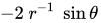
r\theta ~\cos \theta \,{\displaystyle -2~r^{-1}~\sin \theta \,}  
r~\ln r~\cos \theta \,r^{{-1}}~\cos \theta \,  
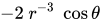
r^{{-1}}~\cos \theta \,-2~r^{{-3}}~\cos \theta \,  
r^{3}~\sin \theta \,2~r~\sin \theta \,  
r\theta ~\sin \theta \,2~r^{{-1}}~\cos \theta \,  
r~\ln r~\sin \theta \,r^{{-1}}~\sin \theta \,  
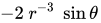
r^{{-1}}~\sin \theta \,-2~r^{{-3}}~\sin \theta \,  
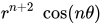
r^{{n+2}}~\cos(n\theta )\,-(n+1)(n-2)~r^{n}~\cos(n\theta )\,  
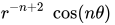
r^{{-n+2}}~\cos(n\theta )\,-(n+2)(n-1)~r^{{-n}}~\cos(n\theta )\,  
r^{n}~\cos(n\theta )\,-n(n-1)~r^{{n-2}}~\cos(n\theta )\,  
r^{{-n}}~\cos(n\theta )\,-n(n+1)~r^{{-n-2}}~\cos(n\theta )\,  
r^{{n+2}}~\sin(n\theta )\,-(n+1)(n-2)~r^{n}~\sin(n\theta )\,  
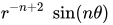
r^{{-n+2}}~\sin(n\theta )\,-(n+2)(n-1)~r^{{-n}}~\sin(n\theta )\,  
r^{n}~\sin(n\theta )\,-n(n-1)~r^{{n-2}}~\sin(n\theta )\,  
r^{{-n}}~\sin(n\theta )\,-n(n+1)~r^{{-n-2}}~\sin(n\theta )\,  

Displacement componentsEdit

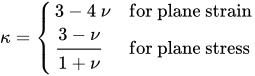
Displacements (u_{r},u_{\theta }) can be obtained from the Michell solution by using the stress-strain and strain-displacement relations. A table of displacement components corresponding the terms in the Airy stress function for the Michell solution is given below. In this table

\kappa ={\begin{cases}3-4~\nu &{\rm {{for~plane~strain}}}\\{\cfrac  {3-\nu }{1+\nu }}&{\rm {{for~plane~stress}}}\\\end{cases}}

where \nu  is the Poisson's ratio, and \mu  is the shear modulus.

\varphi 2~\mu ~u_{r}\, 
r^{2}\,(\kappa -1)~r 
r^{2}~\ln r(\kappa -1)~r~\ln r-r 
\ln r\,-r^{{-1}}\, 
\theta \,{\displaystyle 0} 
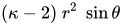
r^{3}~\cos \theta \,(\kappa -2)~r^{2}~\cos \theta \, 
r\theta ~\cos \theta \,{\frac  {1}{2}}[(\kappa -1)\theta ~\cos \theta +\{1-(\kappa +1)\ln r\}~\sin \theta ]\, 
r~\ln r~\cos \theta \,{\frac  {1}{2}}[(\kappa +1)\theta ~\sin \theta -\{1-(\kappa -1)\ln r\}~\cos \theta ]\, 
r^{{-1}}~\cos \theta \,r^{{-2}}~\cos \theta \, 
r^{3}~\sin \theta \,(\kappa -2)~r^{2}~\sin \theta \, 
r\theta ~\sin \theta \,{\frac  {1}{2}}[(\kappa -1)\theta ~\sin \theta -\{1-(\kappa +1)\ln r\}~\cos \theta ]\, 
r~\ln r~\sin \theta \,-{\frac  {1}{2}}[(\kappa +1)\theta ~\cos \theta +\{1-(\kappa -1)\ln r\}~\sin \theta ]\, 
r^{{-1}}~\sin \theta \,r^{{-2}}~\sin \theta \, 
r^{{n+2}}~\cos(n\theta )\,(\kappa -n-1)~r^{{n+1}}~\cos(n\theta )\, 
r^{{-n+2}}~\cos(n\theta )\,(\kappa +n-1)~r^{{-n+1}}~\cos(n\theta )\, 
r^{n}~\cos(n\theta )\,-n~r^{{n-1}}~\cos(n\theta )\, 
r^{{-n}}~\cos(n\theta )\,n~r^{{-n-1}}~\cos(n\theta )\, 
r^{{n+2}}~\sin(n\theta )\,(\kappa -n-1)~r^{{n+1}}~\sin(n\theta )\, 
r^{{-n+2}}~\sin(n\theta )\,(\kappa +n-1)~r^{{-n+1}}~\sin(n\theta )\, 
r^{n}~\sin(n\theta )\,-n~r^{{n-1}}~\sin(n\theta )\, 
r^{{-n}}~\sin(n\theta )\,n~r^{{-n-1}}~\sin(n\theta )\, 

Note that a rigid body displacement can be superposed on the Michell solution of the form

{\begin{aligned}u_{r}&=A~\cos \theta +B~\sin \theta \\u_{\theta }&=-A~\sin \theta +B~\cos \theta +C~r\\\end{aligned}}

to obtain an admissible displacement field.

This article uses material from the Wikipedia article
 Metasyntactic variable, which is released under the 
Creative Commons
Attribution-ShareAlike 3.0 Unported License
.