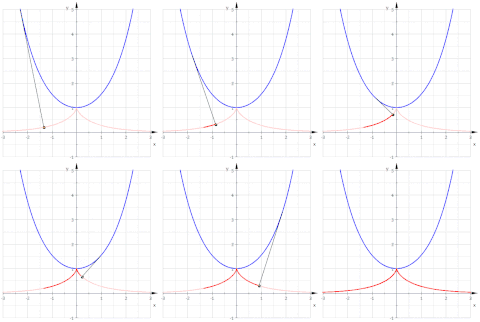
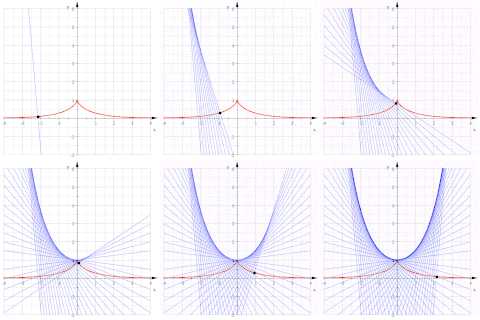
In mathematics, an involute (also known as an evolvent) is a particular type of curve that is dependent on another shape or curve. An involute of a curve is the locus of a point on a piece of taut string as the string is either unwrapped from or wrapped around the curve.[1]
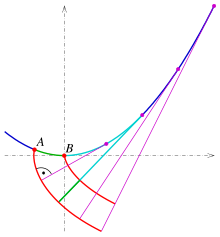
Two involutes (red) of a parabola
Not to be confused with involution (mathematics).
It is a class of curves coming under the roulette family of curves.
The evolute of an involute is the original curve.
The notions of the involute and evolute of a curve were introduced by Christiaan Huygens in his work titled Horologium oscillatorium sive de motu pendulorum ad horologia aptato demonstrationes geometricae (1673).[2]
Involute of a parameterized curveEditSee also: Arc length
Let ![{\displaystyle {\vec {c}}(t),\;t\in [t_{1},t_{2}]}](https://wikimedia.org/api/rest_v1/media/math/render/svg/b014b9d8601fa970d2eaa1f8132f2f34ec432233) be a regular curve in the plane with its curvature nowhere 0 and
be a regular curve in the plane with its curvature nowhere 0 and  , then the curve with the parametric representation

is an involute of the given curve.
Proof The string acts as a tangent to the curve  . Its length is changed by an amount equal to the arc length traversed as it winds or unwinds. Arc length of the curve traversed in the interval ![{\displaystyle [a,t]}](https://wikimedia.org/api/rest_v1/media/math/render/svg/1b7e4d6424116f83d1d8eadea305b1ccc9c8744e) is given by 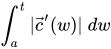
where  is the starting point from where the arc length is measured. Since the tangent vector depicts the taut string here, we get the string vector as is the starting point from where the arc length is measured. Since the tangent vector depicts the taut string here, we get the string vector as 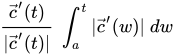
The vector corresponding to the end point of the string ( ) can be easily calculated using vector addition, and one gets ) can be easily calculated using vector addition, and one gets
|
Adding an arbitrary but fixed number  to the integral
 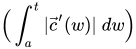 results in an involute corresponding to a string extended by (like a ball of wool yarn having some length of thread already hanging before it is unwound). Hence, the involute can be varied by constant and/or adding a number to the integral (see Involutes of a semicubic parabola).
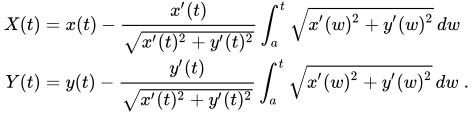
If  one gets
Properties of involutesEditExamplesEditInvolutes of a circleEdit

Involutes of a circle
For a circle with parametric representation  , one has
  . Hence
  , and the path length is
  .
.
Evaluating the above given equation of the involute, one gets
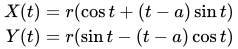
for the parametric equation of the involute of the circle.
The term is optional; it serves to set the start location of the curve on the circle. The figure shows involutes for  (green),
  (red),
  (purple) and
  (light blue). The involutes look like Archimedean spirals, but they are actually not.
The arc length for and  of the involute is

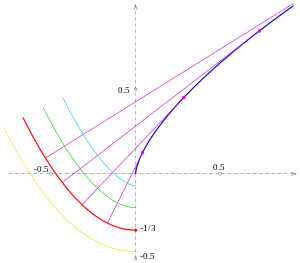
Involutes of a semicubic parabola (blue). Only the red curve is a parabola.
Involutes of a semicubic parabolaEdit
The parametric equation 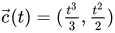 describes a semicubical parabola. From
 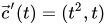 one gets
  and
and  . Extending the string by
  extensively simplifies further calculation, and one gets
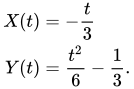
Eliminating t yields 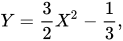 showing that this involute is a parabola.
The other involutes are thus parallel curves of a parabola, and are not parabolas, as they are curves of degree six (See Parallel curve § Further examples).
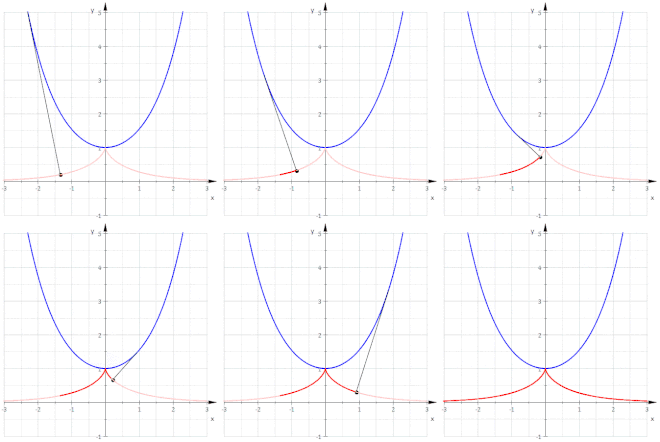
The red involute of a catenary (blue) is a tractrix.
Involutes of a catenaryEdit
For the catenary  , the tangent vector is
  , and, as
  its length is
 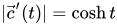 . Thus the arc length from the point (0, 1) is
Hence the involute starting from (0, 1) is parametrized by

and is thus a tractrix.
The other involutes are not tractrices, as they are parallel curves of a tractrix.
Involutes of a cycloidEdit
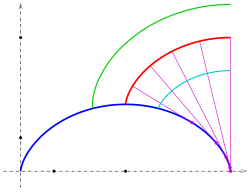
Involutes of a cycloid (blue): Only the red curve is another cycloid
The parametric representation  describes a cycloid. From
  , one gets (after having used some trigonometric formulas)
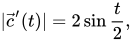
and
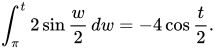
Hence the equations of the corresponding involute are


which describe the shifted red cycloid of the diagram. Hence
- The involutes of the cycloid
 are parallel curves of the cycloid

(Parallel curves of a cycloid are not cycloids.)
Involute and evoluteEditThe evolute of a given curve  consists of the curvature centers of . Between involutes and evolutes the following statement holds: [3][4]
- A curve is the evolute of any of its involutes.
Tractrix (red) as an involute of a catenary
The evolute of a tractrix is a catenary
The involute has some properties that makes it extremely important to the gear industry: If two intermeshed gears have teeth with the profile-shape of involutes (rather than, for example, a traditional triangular shape), they form an involute gear system. Their relative rates of rotation are constant while the teeth are engaged. The gears also always make contact along a single steady line of force. With teeth of other shapes, the relative speeds and forces rise and fall as successive teeth engage, resulting in vibration, noise, and excessive wear. For this reason, nearly all modern gear teeth bear the involute shape.[5]
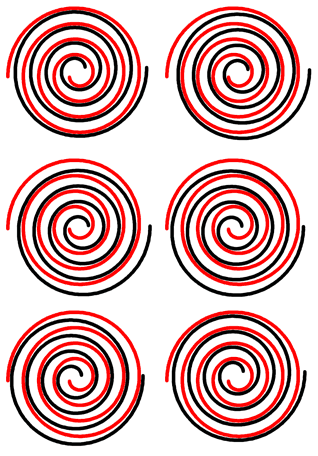
Mechanism of a scroll compressor
The involute of a circle is also an important shape in gas compressing, as a scroll compressor can be built based on this shape. Scroll compressors make less sound than conventional compressors and have proven to be quite efficient.
The High Flux Isotope Reactor uses involute-shaped fuel elements, since these allow a constant-width channel between them for coolant.





and

the involute is not regular (because
),
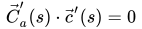
is the tangent of the given curve at point
.
and the fact, that
is the unit normal at
.