In physics, circular motion is a movement of an object along the circumference of a circle or rotation along a circular path. It can be uniform, with constant angular rate of rotation and constant speed, or non-uniform with a changing rate of rotation. The rotation around a fixed axis of a three-dimensional body involves circular motion of its parts. The equations of motion describe the movement of the center of mass of a body. In circular motion, the distance between the body and a fixed point on the surface remains the same.
Examples of circular motion include: an artificial satellite orbiting the Earth at a constant height, a ceiling fan's blades rotating around a hub, a stone which is tied to a rope and is being swung in circles, a car turning through a curve in a race track, an electron moving perpendicular to a uniform magnetic field, and a gear turning inside a mechanism.
Since the object's velocity vector is constantly changing direction, the moving object is undergoing acceleration by a centripetal force in the direction of the center of rotation. Without this acceleration, the object would move in a straight line, according to Newton's laws of motion.
Uniform circular motion
Non-uniform

In non-uniform circular motion an object is moving in a circular path with a varying speed. Since the speed is changing, there is tangential acceleration in addition to normal acceleration.
In non-uniform circular motion the net acceleration (a) is along the direction of Δv, which is directed inside the circle but does not pass through its center (see figure). The net acceleration may be resolved into two components: tangential acceleration and normal acceleration also known as the centripetal or radial acceleration. Unlike tangential acceleration, centripetal acceleration is present in both uniform and non-uniform circular motion.
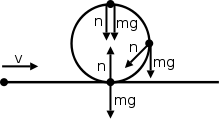
In non-uniform circular motion, normal force does not always point in the opposite direction of weight. Here is an example with an object traveling in a straight path then loops a loop back into a straight path again.
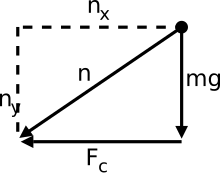
This diagram shows the normal force pointing in other directions rather than opposite to the weight force. The normal force is actually the sum of the radial and tangential forces. The component of weight force is responsible for the tangential force here (We have neglected frictional force). The radial force (centripetal force) is due to the change in direction of velocity as discussed earlier.
In non-uniform circular motion, normal force and weight may point in the same direction. Both forces can point down, yet the object will remain in a circular path without falling straight down. First let's see why normal force can point down in the first place. In the first diagram, let's say the object is a person sitting inside a plane, the two forces point down only when it reaches the top of the circle. The reason for this is that the normal force is the sum of the tangential force and centripetal force. The tangential force is zero at the top (as no work is performed when the motion is perpendicular to the direction of force applied. Here weight force is perpendicular to the direction of motion of the object at the top of the circle) and centripetal force points down, thus normal force will point down as well. From a logical standpoint, a person who is travelling in the plane will be upside down at the top of the circle. At that moment, the person's seat is actually pushing down on the person, which is the normal force.
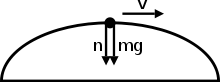
The reason why the object does not fall down when subjected to only downward forces is a simple one. Think about what keeps an object up after it is thrown. Once an object is thrown into the air, there is only the downward force of earth's gravity that acts on the object. That does not mean that once an object is thrown in the air, it will fall instantly. What keeps that object up in the air is its velocity. The first of Newton's laws of motion states that an object's inertia keeps it in motion, and since the object in the air has a velocity, it will tend to keep moving in that direction.
A varying angular speed for an object moving in a circular path can also be achieved if the rotating body does not have an homogeneous mass distribution. For inhomogeneous objects, it is necessary to approach the problem as in.[2]
Applications
Solving applications dealing with non-uniform circular motion involves force analysis. With uniform circular motion, the only force acting upon an object traveling in a circle is the centripetal force. In non-uniform circular motion, there are additional forces acting on the object due to a non-zero tangential acceleration. Although there are additional forces acting upon the object, the sum of all the forces acting on the object will have to be equal to the centripetal force.
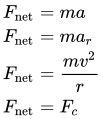
Radial acceleration is used when calculating the total force. Tangential acceleration is not used in calculating total force because it is not responsible for keeping the object in a circular path. The only acceleration responsible for keeping an object moving in a circle is the radial acceleration. Since the sum of all forces is the centripetal force, drawing centripetal force into a free body diagram is not necessary and usually not recommended.
Using 


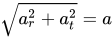
In uniform circular motion, total acceleration of an object in a circular path is equal to the radial acceleration. Due to the presence of tangential acceleration in non uniform circular motion, that does not hold true any more. To find the total acceleration of an object in non uniform circular, find the vector sum of the tangential acceleration and the radial acceleration.
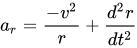
Radial acceleration is still equal to 



| This article uses material from the Wikipedia article Metasyntactic variable, which is released under the Creative Commons Attribution-ShareAlike 3.0 Unported License. |